
(OBSOLETE, See RI-200)
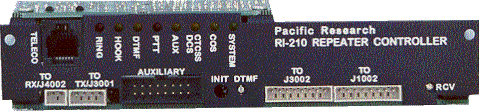
The RI-210 Repeater Controller, telephone interface and tone panel was designed from the ground up to install directly inside the Vertex Repeater. All installation cables are included. No special tools are required to install the RI-210 Repeater Controller.
The microprocessor-controlled RI-210 is not just another repeater controller. Unlike many other repeater controllers, the RI-210 comes fully equipped with a full CTCSS and DCS (Digital Coded Squelch) tone panel, on board squelch SmartSquelch, full duplex telephone interconnect, remote level control and auxiliary expansion port. With the auxiliary expansion port, you can connect multiple repeaters, links and remotes together. All critical functions are included on board – CW ID, Squelch, telephone hybrid, CTCSS, DCS and DTMF encoders and decoders.
Note: This repeater is no longer available from Vertex Standard so we are no longer still supplying this controller. Instead, you can interface the RI-200 controller to the VXR-5000 repeater.
REPEATER CONTROLLER
The RI-210 even has a macro command editor. You can create and assign a 1 to 4 digit name for your own custom user commands. The RI-210 comes preprogrammed with some user commands, including turning the repeater, CTCSS and other items on and off.
INSTALLATION AND SETUP
A built-in receiver audio level meter will help you to assure that your installation is perfect. All you need to do is send a known deviation level on the input of the repeater, press a button and adjust the receiver audio level until the correct number of lights are lit.
CTCSS and DCS OPERATION
Multiple decode CTCSS tones and DCS codes can be used with out any additional hardware. This enables you to decode up to 154 different codes (50 CTCSS and 104 DCS) and to turn on or off each one independently. Both CTCSS and DCS can be used together on your system. The RI-210 incorporates these tone panel features into six separate tone panels. One tone panel for repeater operation, one for user command control, one for system command control, one for dial click control, one for telephone usage and one for the auxiliary I/O port. You can have one group of tones for repeater access only and another group of tones for telephone operation.
The RI-210 can also cross encode tones. Any of the decoded tones or codes can be assigned a different encode tone or code. Example, when you decode 100.0 Hz you can encode 127.3 Hz and when you decode 131.8 Hz you can encode DCS code 023.
USER PROGRAMMABLE INPUTS AND OUTPUTS
USER PROGRAMMABLE SCHEDULER
The scheduler also has additional features such as, repeater inactivity timer, interval timer and internal events (COS, CTCSS, PTT, etc.). If the CTCSS or DCS decode was turned off, you can program your repeater to turn the CTCSS and DCS decode back on after a programmed time of no activity. Use the PTT event to turn on a fan and keep the fan on for a programmable period of time after the transmitter is off the air.
REMOTELY ADJUSTABLE AUDIO
SQUELCH (SmartSquelch)
USER PROGRAMMING
SELF BALANCING DUPLEX TELEPHONE INTERCONNECT
Through programming, you can setup the telephone interconnect for either half duplex, full duplex or half duplex privacy modes. In the half duplex privacy mode, the mobile audio is muted to prevent other people from hearing the mobile side if the conversation.
The RI-210 also supports 99 auto dial number and a last number re-dial.
TOLL RESTRICTION
LINE BUSY
SELECTIVE CALLING
TELEPHONE CONTROLLING
STANDARD FEATURES
- Plugs directly inside the Vertex VXR-5000 Commercial-Grade Repeater and is complete with pre-aligned audio levels.
- All features are remotely programmable via radio or telephone.
- Intelligent telephone interface with automatic hybrid balance on every call.
- Reverse patch with selective calling. CTCSS, DCS and DTMF.
- 99 number auto-dial and last number re-dial.
- Full featured toll restriction.
- Telephone interface includes a microprocessor controlled AGC (Automatic Gain Control).
- Programmable CW identifier.
- System status display panel. All critical audio level adjustments are remotely settable via radio or telephone.
- On board Squelch circuit, SmartSquelch.
- An intelligent microprocessor controlled squelch, it’s fast and it’s remotely programmable via radio or telephone.
- Full CTCSS and DCS decode and encode, including standard tone panel features.
- Multiple CTCSS tones and/or DCS codes may be decoded.
- 154 users (50 CTCSS and 104 DCS) remotely programmable via radio or telephone.
- On board selectable sub-audio and splatter filters.
- System scheduler, automatically execute commands at pre-programmed times.
- DTMF decode and encode with mute, pass or regenerate features.
- Push to Talk control. You can build user commands for users without DTMF equipped radios.
- Programmable time out and courtesy timers.
- WATCH DOG and Power supply supervisory circuit.
- NON-VOLATILE EEPROM data storage.
- System data is stored without a memory backup battery.
- Auxiliary interface, connect two controllers together for linking or multiple repeater operation.
- Macro Programming allows full customizing of the repeater user commands.
- Low power consumption, less than 60mA, Ideal for solar powered sites.
- Operates from 8 to 15 volts DC.
PROGRAMMABLE FEATURES
- The controller is shipped with default commands, ready for operation.
- Programmable CW identifier, courtesy tones and system messages.
- Remotely program all functions and features.
- Macro programming.
- Build custom user commands.
- User programmable password security.
- Transmit carrier delay time.
- Time-out timer.
- Courtesy timer.
- Macro scheduler.
- Automatically execute commands at preprogrammed times.
- Multiple CTCSS and DCS tone panel decode and encode.
- Six full CTCSS and DCS tone panels, one each for the repeater, telephone, auxiliary link, user commands, system commands and dial click control..
- Programmable Tone generator.
- Remotely programmable audio levels.
- Remotely adjustable squelch.
TELEPHONE FEATURES
- Outgoing telephone calls with accept / reject tables for complete toll restriction.
- 99 number auto dialer and last number re-dial.
- Multiple telephone number prefixing for PBX, cancel call waiting, various long distance providers, etc.
- Programming for multiple credit card account calling.
- Multiple incoming call modes.
- Selective calling, CTCSS, DCS and DTMF.
- Programmable call progress time out timers.
- Automatic hybrid balance on each call.
- Incoming call automatic audio level control.
SPECIFICATION
- Operating voltage: 10 to 15 volts DC.
- Operating current: less than 60 mA with display off.
- Size: Analog 3.5 x 6.1, Display 3.5 x 1.6
- Temperature Range: -30°C to +60°C
- Main CPU: Intel P87C51FB with 8.5K EEPROM
- Squelch: SmartSquelchTM (DSP squelch)
- CTCSS/DCS decoder: MX-Com MX805
- DTMF decoder: Mitel MT8880
- Audio response: ±0.75db, 300 – 3500 Hz
- LPF cutoff: 4500 Hz
- HPF cutoff: 280 Hz
- Hum and Noise: -45db
- Port connection: DB-15.
- Auxiliary buss: 1 Channel full duplex